If you’ve got fleas in the house and a Google search history of “natural flea remedy”, you’ve probably already read about salt, bicarb, lemon spray, essential oils, and diatomaceous earth. Here’s what those actually do, why most fall short on a real infestation, and when you should stop experimenting and call a pro.
Key takeaways
- Most natural methods kill some adult fleas in the immediate area but don’t break the life cycle.
- Adult fleas are only 5% of the population, the other 95% (eggs, larvae, pupae) is hidden where remedies can’t reach.
- Diatomaceous earth is the most effective natural option but works slowly (2-7 days).
- Natural remedies work for early-stage prevention or as complement to professional treatment.
- Professional treatment with adulticide + IGR clears active infestations in one visit.
Quick answer: a few natural methods kill some adult fleas in the immediate area, but none of them break the flea life cycle. That matters because adult fleas are only 5% of the population. The other 95% is eggs, larvae, and pupae buried in the carpet pile and soft furnishings, and natural remedies don’t reach them.
What each natural method actually does
Salt and bicarbonate of soda
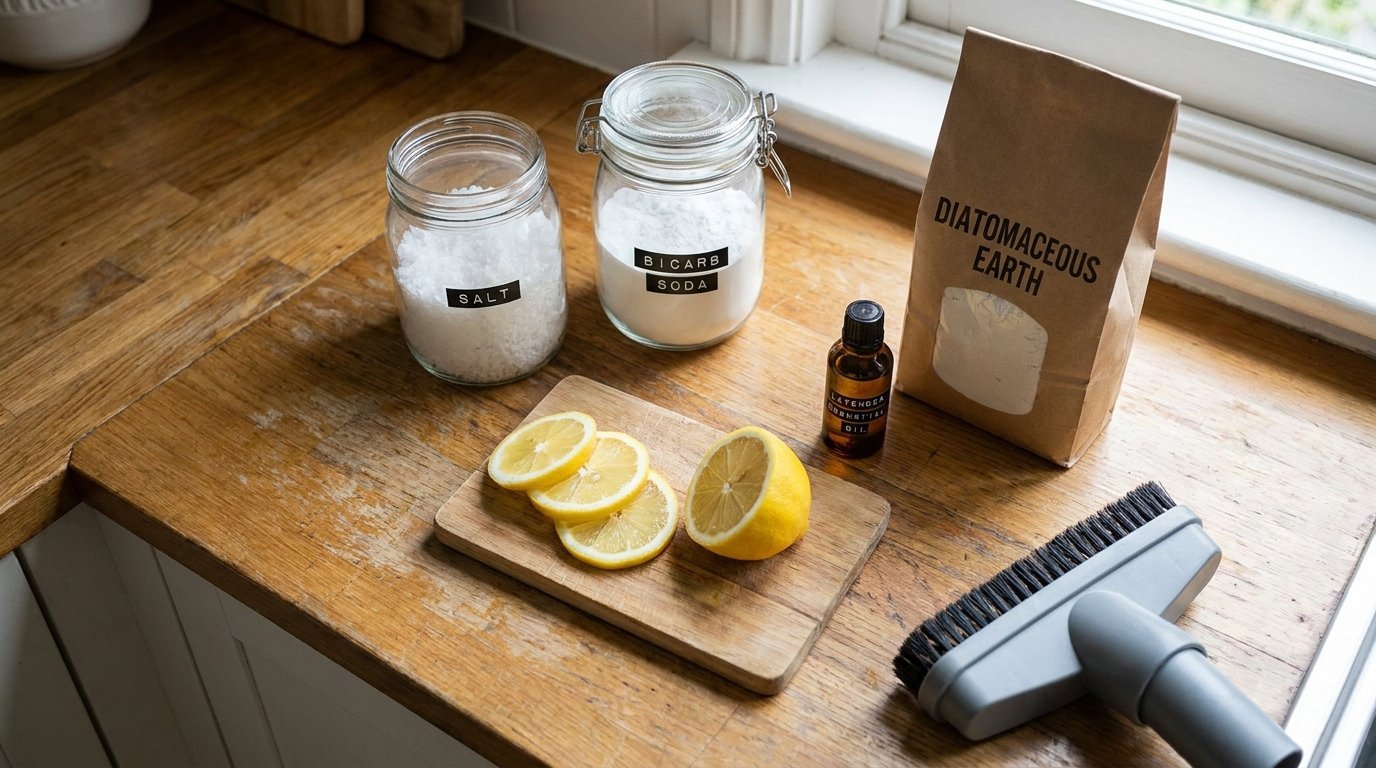
The most-recommended method on every blog. The salt dehydrates adult fleas it makes contact with. Bicarb works similarly. Vacuumed up after 24-48 hours, you’ll capture some adult fleas that crawled through it. The eggs and larvae underneath are untouched.
Lemon spray
Sliced lemon boiled in water, cooled, bottled. Mildly repellent, fleas don’t like the citrus oils. Effect is short-lived once the spray dries, and it does nothing to existing eggs.
Essential oils (rosemary, lavender, peppermint)
Repellent rather than lethal. Some essential oils are toxic to cats, so check before using if you have one in the house.
Diatomaceous earth (food-grade)
The most effective natural option. It’s a fine powder of fossilised algae that physically scratches the flea’s exoskeleton, causing it to dry out. Sprinkled on carpet and worked into the pile, it kills adult fleas and some larvae over 2-7 days. Has to be reapplied after vacuuming and works best in dry conditions.
Dish soap traps
Shallow dish of water with dish soap, placed under a lamp at night. Catches a small number of fleas attracted to the warmth and moisture. Cute trick, but you’re catching maybe 10-30 fleas a night out of a population that can run into the thousands.
Why natural remedies fail on an active infestation
The flea life cycle has four stages: egg, larva, pupa, adult. Adult fleas are about 5% of the total population. The rest is hidden in carpet, skirting boards, soft furnishings, pet bedding.
Why remedies don’t reach the rest
- Don’t penetrate carpet pile to reach larvae
- Don’t kill eggs
- Don’t touch pupae (wrapped in protective cocoons)
- Wear off in days, while pupae can sit dormant for months
The familiar pattern
You sprinkle salt and bicarb. The adult fleas you can see disappear. You think it worked. Two to three weeks later, the cocooned pupae mature, emerge as biting adults, and you’re back where you started. Most people on their third round of natural treatment eventually call a professional.
For the underlying biology, see our carpet flea control deep dive on why 95% of the population is hidden where natural remedies can’t reach.
When natural methods are actually worth using
Three scenarios where natural is the right call.
1. Early-stage prevention
If your dog comes home from the park with one or two fleas and you act within 24 hours, vacuuming aggressively plus diatomaceous earth on carpets can stop the eggs from hatching into a full population.
2. Complement to professional treatment
Continuing to vacuum 7-10 days after a professional spray (note: not too aggressively, you don’t want to strip the residual product) keeps the environment hostile to any survivors.
3. Pregnancy or chemical sensitivity
During pregnancy or in homes with chemical sensitivities, where chemical insecticides need to be avoided. Even then, “natural remedy and grin and bear it” tends to mean a longer infestation. Talk to a pest control company about lower-toxicity professional products if standard chemicals are off the table.
What works when natural runs out of road
A professional flea treatment uses two products together: an adulticide that kills adult fleas on contact, and an insect growth regulator (IGR) that prevents flea eggs from hatching and stops larvae from maturing. The IGR is what no household natural remedy includes. It’s the reason a single professional treatment outperforms three or four DIY rounds.
Cost in Melbourne sits at $175-$300 per visit depending on property size. Treatment takes 60-90 minutes. The residual product keeps working against newly-hatched fleas for 8-12 weeks, so the infestation usually clears in one visit.
Related guides on natural flea control
- Flea bites: identification, symptoms, and treatment — if you’ve already got the bumps on your ankles, here’s how to identify and soothe them while the treatment works.
- How to deal with fleas in your Melbourne home: a practical guide — the day-by-day playbook when natural remedies have run out of road.
- Flea control Melbourne: complete guide to professional flea pest control — the head-term reference when you need a licensed operator.
Frequently asked questions
Is salt and bicarb safe for pets?
Yes once vacuumed up. Don’t let pets walk on freshly-sprinkled salt (it can irritate paws and they may lick it).
Which essential oils are toxic to cats?
Tea tree, peppermint, eucalyptus, citrus oils are all toxic to cats. Even diluted sprays can cause issues. If you have a cat, skip essential-oil flea sprays entirely.
Does food-grade diatomaceous earth really work?
It works on adult fleas and some larvae over 2-7 days, in dry conditions. It’s the only natural option with a measurable kill rate, but still can’t reach pupae or eggs deep in carpet pile.
Are there any natural methods that DO break the life cycle?
No household natural remedy includes an insect growth regulator. The closest you get is regular vacuuming + DE + flea preventative on the pet, which combined can starve a small infestation over weeks. For an established infestation, professional is faster and cheaper.
Booking professional treatment
For the full process, see our flea control Melbourne overview. If your DIY natural rounds aren’t working, call (03) 8692 4747 for same-day treatment across Greater Melbourne.