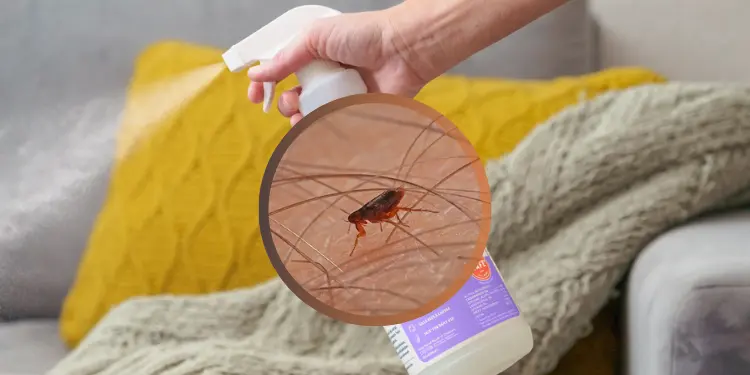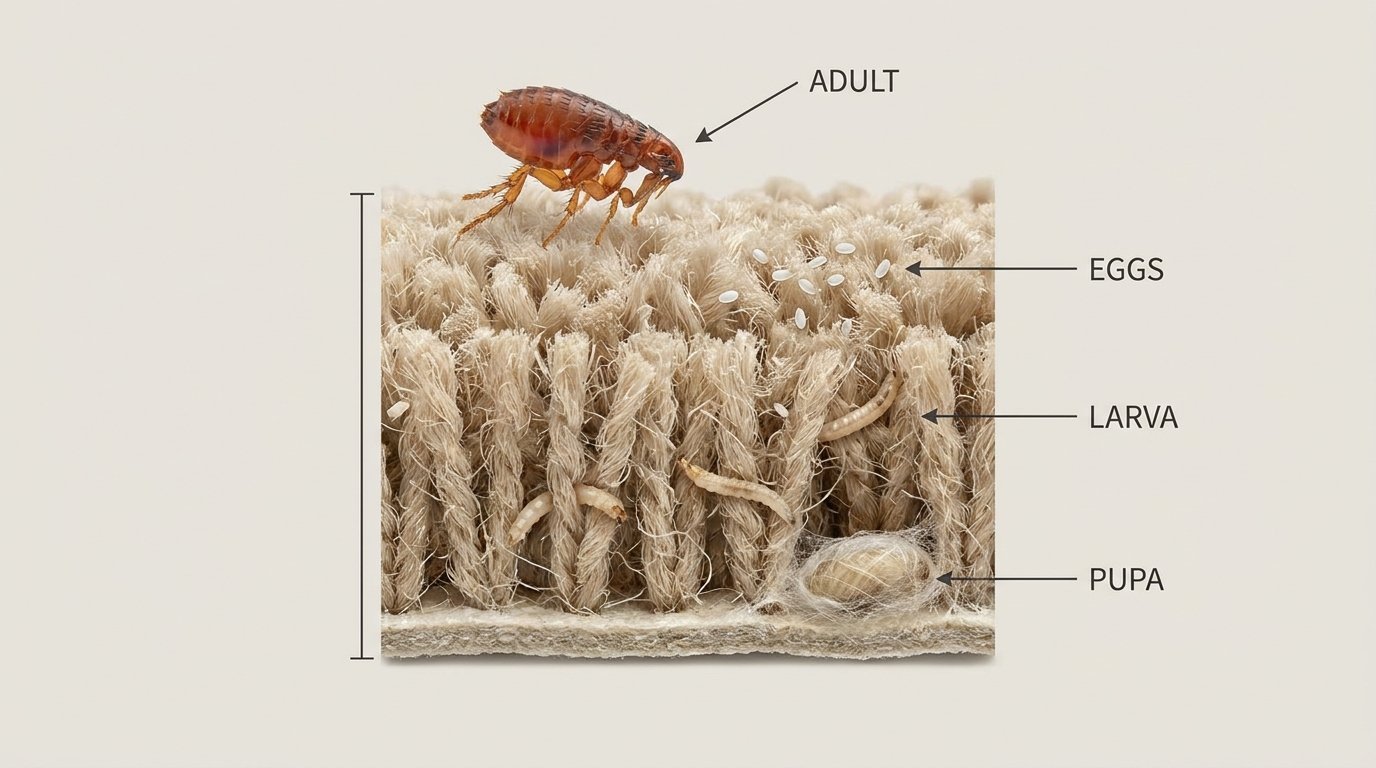
If you’ve found fleas in your home, the carpet is where 95% of the population lives. Adult fleas (the ones you see) are the visible 5%. The eggs, larvae, and pupae are buried deep in the pile, where most household sprays can’t reach. This guide explains why carpets harbour fleas, what actually kills them, and what works in a Melbourne home.
Key takeaways
- 95% of any flea population is hidden in carpet as eggs, larvae, and pupae.
- Pupae are the hardest stage to kill (cocoons resist most insecticides).
- DIY sprays kill adults only, without an IGR, eggs survive and hatch within 2-3 weeks.
- Professional treatment with adulticide + IGR clears in one visit.
- Replacing carpet costs 10-25× more than treatment and rarely solves the problem.
Why fleas live in carpets
Fleas need three things to thrive: warmth, humidity, and a steady food source. Carpet pile gives them all three. The dense fibres trap heat near the floor, hold moisture from foot traffic and ambient humidity, and collect organic debris (skin flakes, pet dander, dust) that flea larvae feed on.
The four life cycle stages
- Egg: laid on the host, falls off into carpet within hours. Hatches in 2-14 days.
- Larva: burrows deep into pile to escape light, feeds on organic debris and adult flea droppings (digested blood).
- Pupa: spins a sticky cocoon. Resistant to most insecticides. Can sit dormant for weeks or months.
- Adult: emerges when it detects vibration, heat, or carbon dioxide nearby. Bites the host, lays eggs, cycle restarts.
Why pupae are the hardest stage
The pupal stage is what makes carpet fleas hard to kill. Cocoons are sticky and resistant to most insecticides. They can sit dormant for weeks or months waiting for a host. That’s why fleas keep coming back 2-3 weeks after a DIY treatment: the cocooned pupae survived and emerged as fresh adults.
What works on carpet fleas (and what doesn’t)
Vacuuming (genuinely useful)
Thorough vacuuming with a beater bar agitates the cocooned pupae and stimulates them to emerge as adults, which makes them vulnerable to whatever you spray next. It also removes some adult fleas, eggs, and larvae directly. Empty the canister or bag into an outside bin straight after.
Salt and bicarbonate of soda
The most-recommended natural method. Dehydrates adult fleas in the immediate area but doesn’t reach the larvae or pupae deeper in the pile. Useful as part of a multi-step approach, ineffective on its own.
Diatomaceous earth
Food-grade diatomaceous earth physically scratches the flea exoskeleton, causing it to dry out. Works on adult fleas and some larvae over 2-7 days. Has to be reapplied after vacuuming and works best in dry conditions.
Household flea sprays
Mortein, Raid, supermarket equivalents kill adult fleas on contact but don’t include an insect growth regulator (IGR). The eggs and larvae survive the spray, and a fresh wave of adults emerges 2-3 weeks later. Most users go through 3-4 rounds and total $150-$250 with no guaranteed result.
Steam cleaning
Steam at 60°C+ kills fleas at all life stages, but only the ones the steam reaches. Larvae buried 5-10mm deep in dense carpet pile can survive a domestic steam cleaner. Combined with vacuuming, steam helps but isn’t a complete solution.
Professional carpet flea treatment
Professional treatment uses two products together: an adulticide (kills adult fleas on contact) and an IGR (prevents eggs from hatching and stops larvae from maturing). The IGR is the key. It’s what no household product includes, and it’s the reason a single professional treatment outperforms three or four DIY rounds. Here’s what to expect when you get your house sprayed for fleas.
Where the spray is targeted
- Carpet pile (worked into the fibres with a low-pressure backpack sprayer)
- Skirting board edges
- Soft furnishings and pet bedding
- Cracks in adjacent flooring
- Low-traffic corners where flea dirt has built up
Residual protection
The residual product keeps working for 8-12 weeks against newly-hatched fleas. Within 5-7 days, cocooned pupae emerge as adults and are killed by the residual. By week 3 the infestation is fully cleared.
Don’t vacuum treated carpets for 7-10 days after the visit. Vacuuming strips out the residual product before it has time to kill the late emergers.
Should you replace the carpet?
People sometimes ask if it’s easier to just rip the carpet out. The answer is almost always no.
The cost comparison
- Professional flea treatment: $175-$300 in Melbourne, clears in one visit
- Carpet replacement: $40-$80 per square metre installed ($2,000-$5,000 for a typical 50sqm home), takes days, doesn’t address the source
When replacement makes sense
If your carpet is at end of life anyway and you were going to replace it within the year, dealing with a flea infestation can bring that timeline forward. Even then, you need a professional flea treatment AFTER laying the new carpet, because the eggs in the underlay can survive the changeover.
Hard floors aren’t immune either. Fleas live in the cracks between boards, in skirting board edges, and in the dust that collects in corners. The infestation just moves location.
Frequently asked questions
How deep do fleas live in carpet?
Larvae burrow 5-10mm into the pile to escape light. Pupae form cocoons at the base of the pile. Adults stay near the top. Vacuuming + professional spray reaches all three.
Will carpet shampoo kill fleas?
Drowns some adults and dilutes flea dirt. Doesn’t reach larvae or pupae and doesn’t include an IGR. Useful before professional treatment, not as a replacement.
How often should carpets be treated?
Most Melbourne households need only one professional treatment per active infestation. The 8-12 week residual handles late emergers and any new arrivals. Repeat treatments are only needed if pets bring in fresh fleas regularly.
Are professional sprays safe for kids and pets?
Yes once dry (2-4 hours after application). The products are registered with the APVMA and non-toxic to mammals at the application rate.
Carpet flea control pricing in Melbourne
Standard carpet flea treatment in Melbourne sits at $175-$300, the same as broader flea control because the products and process are the same. A 1-2 bedroom flat with mostly carpeted living area lands at the lower end. Multi-storey homes or properties with extensive soft furnishings land higher.
If pets spend time outside too, see our outdoor flea control guide for the yard side of the problem. For the broader picture of flea control beyond carpets, see our flea control Melbourne overview.
Ready to book? Call (03) 8692 4747 for same-day flea treatment across Greater Melbourne.